Syracuse Has No Town Beach, So Ortigia Swims Off the Rocks
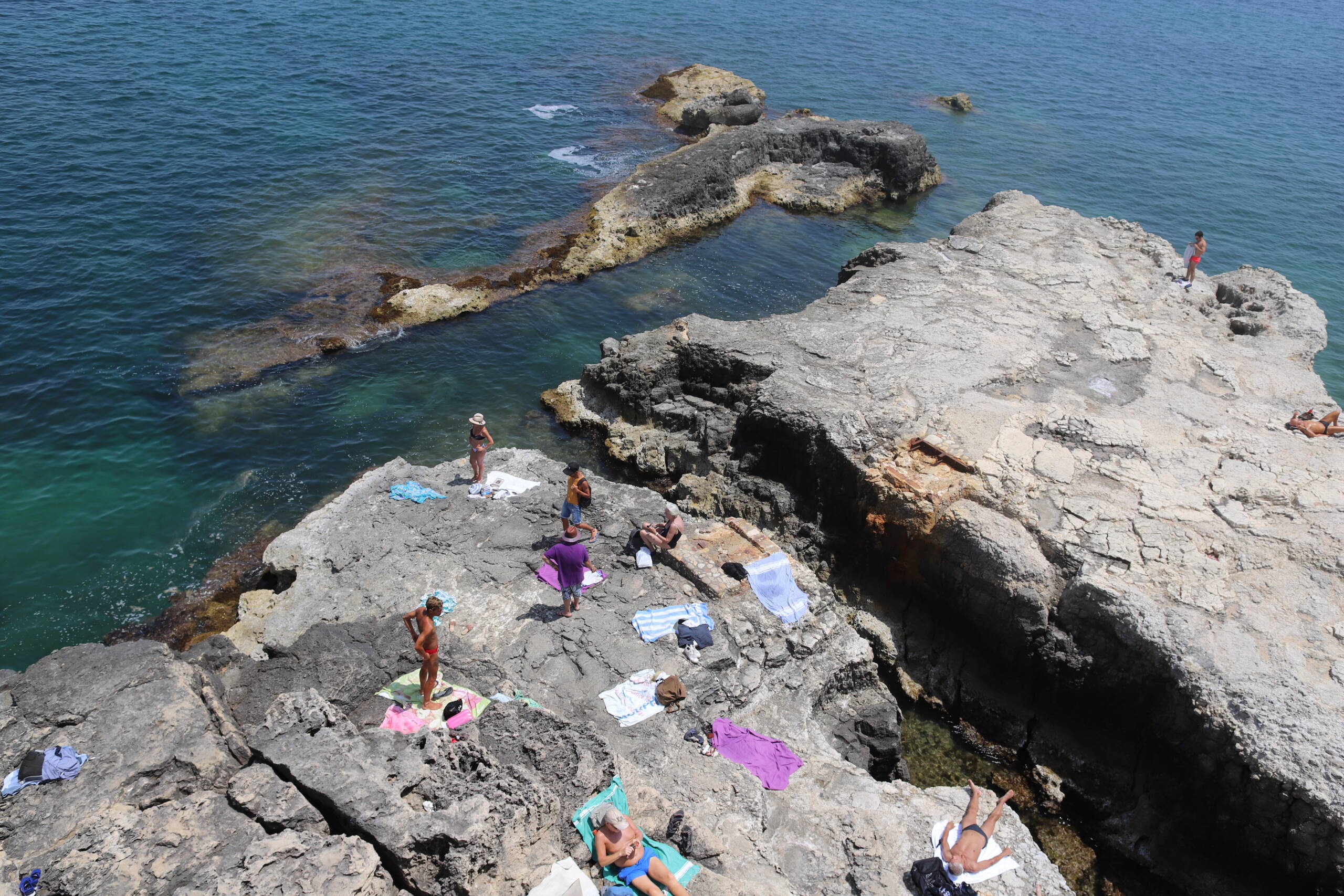
Stand on the sea wall on Ortigia’s Ionian side on a summer morning and look straight down. That’s the beach. A shelf of pale grey limestone, cracked and pitted, with towels spread across it like it was sand. Nobody paid to be there, and nobody seems to mind that the ground is hard.
In the frame I shot from up there, a man in a red Speedo stands with his hands on his hips, looking like he’s still deciding whether to go in. A woman in a sunhat has walked right out to the lip of the rock. Further along an older guy lies flat on his back on a white towel, arms flung out, completely gone. Nobody’s performing for anyone. This is just where people in Ortigia swim.
Ortigia is the small island that holds Syracuse’s old town, tied to the mainland by a couple of short bridges. It has the Duomo, with the columns of a Greek temple still standing inside its walls, and the Maniace castle out on the southern tip. What it doesn’t have is much sand.
The rock does the job
Limestone coast drops away fast. A step or two off the ledge and you’re in deep, clear water that runs pale green over the submerged shelves and turns dark blue a few metres out. Look at the channel on the right side of the photo, where the sea has cut a slot into the rock. You can see the bottom.
There’s old ironwork in the stone if you look for it. Rusted brackets, the stumps of what were probably ladders, patches of brick and mortar that look like steps somebody built and the sea slowly took back. People have been fixing up this coast for their own use for a long time, a bit at a time.
The summer decks
From early June to the end of September a big wooden sundeck goes up at Forte Vigliena, the little castle-shaped fort on the Lungomare. It’s free, there are showers and ladders down into the water, and it fills up early because the locals know to get there first. A couple of paid solariums nearby have loungers and a bar if you’d rather have a sunbed than a towel on the boards.
Outside those months, or anywhere away from the decks, it’s just the bare rock. Plenty of people like it better that way.
If you really want something that feels like a beach, Cala Rossa is a small public cove of stones on the same stretch. There’s a scrap of sand at the end of the Marina too, on the harbour side, but that’s port water and most people cross over to the open sea.
What to bring
Water shoes, first. The rock is sharp in places and slick where it’s wet, and the metal ladders get slippery. There’s almost no shade, so an umbrella makes a real difference, and there are no toilets at Forte Vigliena (bring water, bring snacks). Go early to get a spot, or go late. The view back along the seafront to the castle at sunset is better than anything you’ll get at noon.
Sand, if you need it, means leaving town. Arenella and Fontane Bianche are to the south, and the Plemmirio marine reserve has rocky coves about twenty minutes away by car.
Most visitors never bother. They walk down from the Lungomare, find a flat bit of rock and lie down.