Venice's Temporary Bridges: Which Ones Float, Which Ones Stand on Piles
Shoot the Grand Canal at night and you eventually catch something that shouldn’t be there. A steel and timber walkway running out over the water on driven piles, X-braced trestles, a truss railing, one sodium lamp doing all the work, a couple standing halfway across looking at nothing in particular. Behind it a Gothic palazzo with its window tracery lit, and further back a lit loggia throwing orange across the black water.
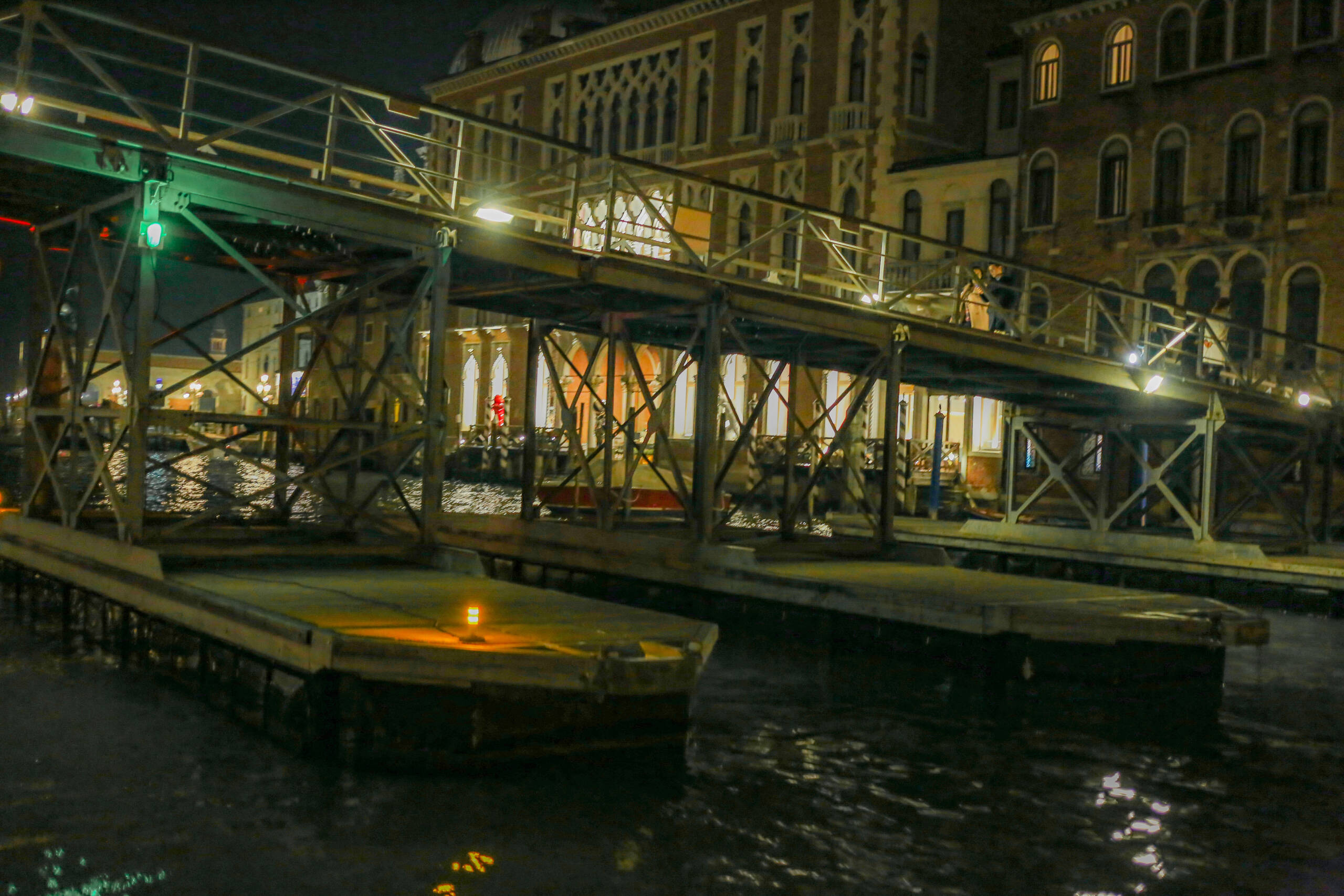
The reflex is to assume it’s the famous one. Venice builds a bridge across the Grand Canal every November, so this must be it.
It isn’t. And the difference between the two is the whole point.
The votive bridges float
Venice has two temporary bridges that are genuinely annual, and both are votive. They exist because the city made a promise during a plague and has never stopped keeping it.
The Redentore bridge goes up in July, crossing the Giudecca Canal from the Zattere to Palladio’s church of the Redentore. It marks the end of the 1576 outbreak. The Salute bridge goes up in November, crossing the Grand Canal from Campo Santa Maria del Giglio to Longhena’s basilica at the tip of Dorsoduro, marking the end of the 1630 one. That one is up around the twenty-first, stands for a few days, and carries a slow shuffle of Venetians going to light candles, plus the queue for the castradina stalls.
Both of them float. They are pontoon bridges laid on barges, roped and pinned into a line, decked over, railed, and then taken apart again. You can feel them move under you. That’s the tell, and it’s the thing people remember.
Nothing on piles is a votive bridge. If it’s standing on legs sunk into the lagoon bed, it’s something else entirely.
The other temporary Venice
The something else is the more interesting category, because there’s much more of it and nobody photographs it on purpose.
Venice runs on structures that are meant to come down and mostly don’t. When a vaporetto stop gets rebuilt, or a fondamenta is closed for wall repair, or a hotel gets its water entrance redone, the contractor drives a fresh set of pilings and builds a bypass. Walkway, handrail, a light every so many metres, sometimes a green signal lamp bolted to a bracket so boat traffic knows the span is clear. It goes up in weeks and stays for however long the works take, which in Venice is never the number written on the permit.
Then there are the passerelle for acqua alta, the raised trestle walkways stacked in yards around the city and deployed along the main routes when the tide is forecast high. Those are a different animal again, low metal frames with plank tops, elevated maybe a metre, and they turn the busiest calli into single-file queues. MOSE has cut down how often they appear in Piazza San Marco, but they haven’t gone away.
Add the loading platforms, the scaffolding decks over side canals, the pontoons parked alongside a facade under restoration. The city has a permanent supply of provisional structures.
What it means for the photograph
If you’re shooting Venice at night, this stuff is a gift and most people walk past it.
A votive bridge is a straight line of deck with a crowd on it. Handsome, but flat. A working structure on piles gives you depth: the lit background gets sliced into panels by the bracing, a walkway railing cuts a hard diagonal through the frame, and the pilings repeat down into the dark. You get layers for free. Shoot it wide from a vaporetto deck or the far bank and let the lit palazzo behind read through the gaps.
It also gives you the honest version of the city. The postcard Venice is stone and water. The real one is stone, water, and a great deal of scaffolding.
So if you want to walk the November bridge, come on the twenty-first and look for the one that wobbles. Everything else you see out over the canal is just the city getting on with the repairs.