Yayoi Kusama, Japanese Artist of Dots, Nets and Infinity Rooms, Dies at 97
Yayoi Kusama, who spent seventy years painting the hallucinations she had experienced since childhood and became one of the most widely seen artists alive in the process, died on August 14 at a hospital in Tokyo. She was 97. Her studio announced the death on Thursday. Kyodo News reported the cause as multiple organ failure. The studio’s own statement gave no cause and said she had gone on painting until her final days.
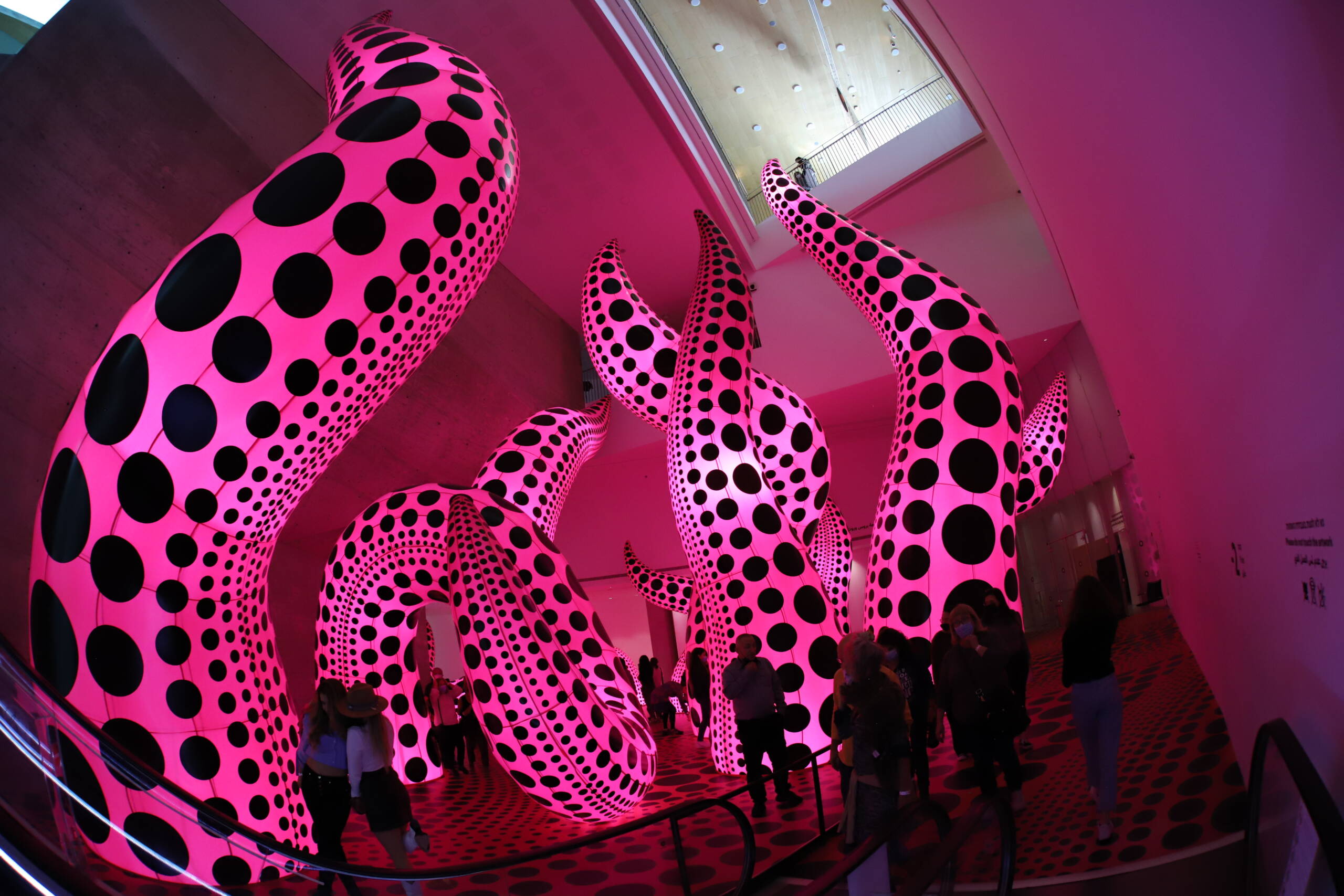
She was born on March 22, 1929, in Matsumoto, in Nagano prefecture, into a prosperous family and an unhappy house. By around the age of ten she was seeing what she later described as flashes of light and dense fields of dots spreading across whatever was in front of her. She began drawing them. During the war she was sent to work in a military factory sewing parachutes for the imperial army, an adolescence spent in a dim workshop stitching fabric for men who were not coming back.
Her family opposed her becoming an artist. She studied nihonga, the traditional Japanese painting style, in Kyoto, and disliked it. In the mid-1950s she found a copy of Georgia O’Keeffe’s work in a secondhand bookshop, tracked down the American painter’s address, and wrote to her. O’Keeffe wrote back and offered encouragement. In 1957 Kusama left for the United States at 27, arriving in Seattle before settling in New York.
New York
She arrived with almost nothing and worked at a scale she could not afford. The Infinity Nets, enormous canvases covered edge to edge in small repeated loops of paint, were the first works to get her noticed, and she painted them obsessively, sometimes for days without stopping. Out of the same impulse came the soft sculptures: furniture, boats and shoes encrusted with hundreds of stuffed fabric protrusions.
In 1965 she built the first of the mirror rooms, Infinity Mirror Room — Phalli’s Field, filling a mirrored chamber with red-spotted white tubers so that the field appeared to extend without end. It was the beginning of the format that would eventually make her famous to millions of people who could not name another living artist.
In 1966 she went to the Venice Biennale without an invitation and laid 1,500 mirrored plastic spheres on the lawn outside the Italian Pavilion. Wearing a gold kimono, she moved among them selling the balls to passersby for two dollars each, beside a sign offering narcissism for sale. Officials were not amused and moved to stop her. The piece, Narcissus Garden, is now in museum collections on four continents.
The late 1960s were her most public and most confrontational years. She staged happenings in which participants stripped and she painted dots on their skin, on the Brooklyn Bridge, in Central Park, in the sculpture garden at the Museum of Modern Art. Some were explicitly anti-war, protesting the deaths of young Americans in Vietnam. The banners said self-obliteration, which was her term for what the dots did: multiply until the boundary between a person and everything else stopped holding. Andy Warhol and Claes Oldenburg both later acknowledged her influence, and for years afterward she argued that neither of them had acknowledged it enough.
Return, and Obscurity
She came back to Japan for good in 1973, in poor health and largely forgotten by the New York art world she had helped shape. The Japanese press had been hostile to her for years. In 1977 she admitted herself to a psychiatric hospital in Tokyo and lived there for the rest of her life, crossing the street each morning to her studio and working through the day. She published novels and poetry. She kept painting through roughly fifteen years in which very few people were paying attention.
The recovery began in the late 1980s with a retrospective in New York, and was sealed in 1993 when she was invited to represent Japan at the Venice Biennale, the first individual artist and the only woman to be given the Japanese pavilion. Twenty-seven years after being thrown off the lawn, she was the official entry.
The Last Three Decades
What followed was one of the largest expansions of audience in the history of contemporary art. The mirror rooms toured the world and broke attendance records wherever they went. She collaborated twice with Louis Vuitton, in 2012 and again in 2023, covering flagship stores from Paris to Tokyo in her dots. A museum devoted to her work opened in Tokyo in 2017. She received the Praemium Imperiale, Japan’s leading international art award.
The market followed the crowds. An early Infinity Nets painting sold for nearly $10.5 million in May 2022, a record for her work, and her output brought a combined $190.5 million at auction in 2023 alone, placing her among the best-selling artists in the world.
She was direct about what the work was for. She said repeatedly that making art was the only thing that had relieved her illness, and that she was fighting to keep going so that people would still be interested after she was gone. She was ninety-seven, and she was still at the easel.