MSC Salerno: What a 16,196-TEU LNG Dual-Fuel Container Ship Demands From the Network Around It
Modern supply chains run on a small number of very large ships. Raw materials, components and finished goods move across the same ocean corridors in the same steel boxes, and the economics of the whole system depend on how many of those boxes can be stacked on one hull and moved at once. The MSC Salerno is a useful specimen because she is new, she is typical of what is being ordered now, and her dimensions were not chosen freely.
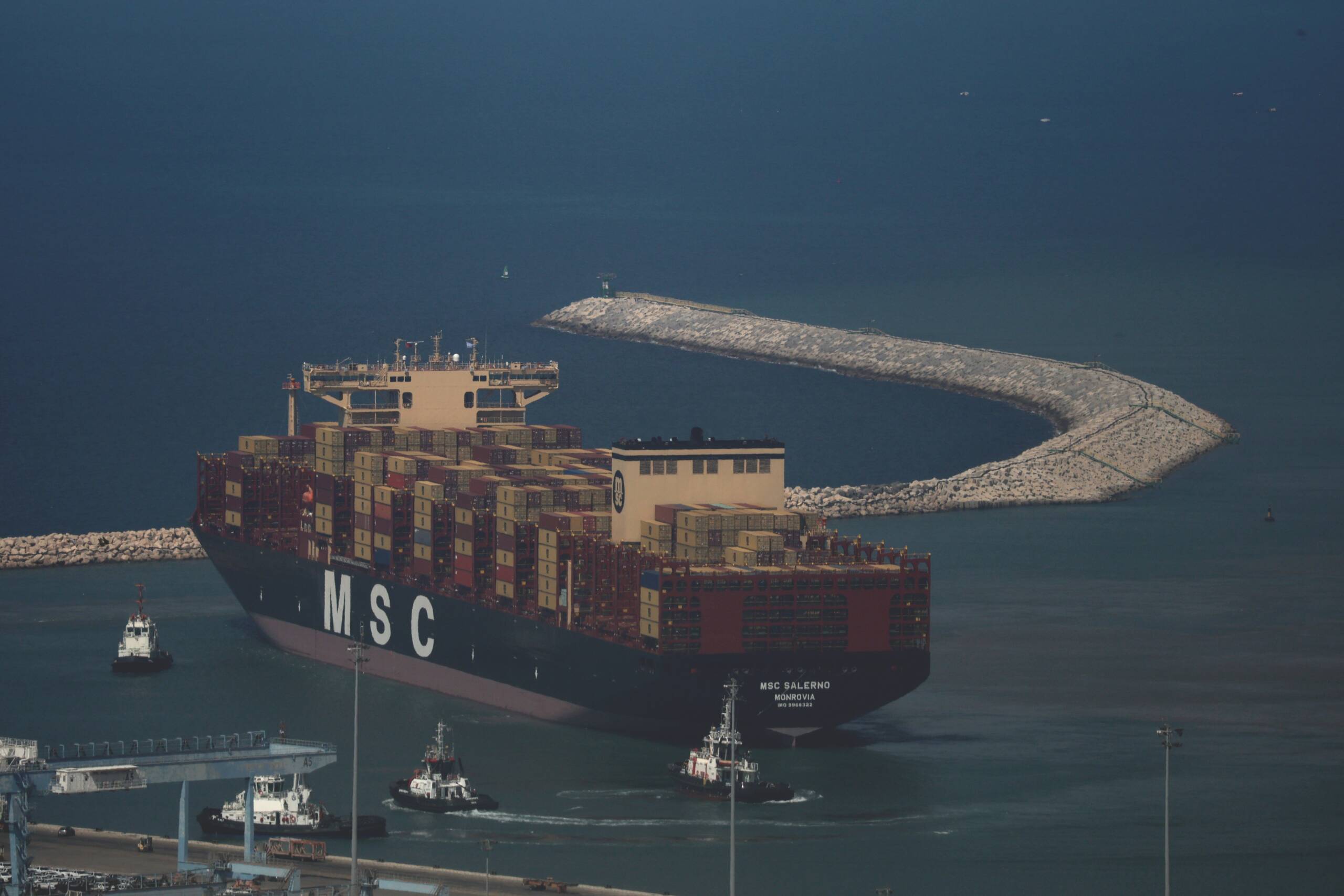
She was delivered on 30 October 2025 by CSSC Tianjin, a Dalian Shipbuilding subsidiary, 93 days ahead of the contractual date. That detail is worth more than it looks. Chinese yards delivering a quarter early on a complex dual-fuel newbuild says something about where container tonnage is being built and how fast. The ship measures 366 meters long, 51 wide and 30.2 deep, carries 16,196 TEU nominal, and has 1,800 reefer plugs. She sails under the Liberian flag with Monrovia on the stern, and she arrived alongside the MSC Grace from Yangzijiang in the week MSC became the first carrier to pass seven million TEU of fleet capacity, having gone from six million in about fifteen months.
The dimensions are a lock, not a choice
366 by 51 is not a round number picked for efficiency. It is very close to the maximum envelope of the expanded Panama Canal locks, which accept vessels up to 366 meters long and around 51 meters in beam. Ships built to that limit are called Neo-Panamax, and the whole class exists because a hull one meter wider loses access to a canal that connects Asia to the US East Coast.
This matters for how you read the ship. She is not a maximal vessel. The largest boxships in service run past 400 meters and 24,000 TEU, and those are effectively Asia to Northern Europe machines, unable to transit Panama and too deep for most terminals. A 16,000 TEU Neo-Panamax is the flexible workhorse: big enough to capture most of the unit-cost advantage, constrained enough to be deployable on many more strings. Carriers are ordering this size heavily for exactly that reason.
TEU itself deserves a note, because the figure is routinely misread. It is a volume unit, not a weight one. One twenty-foot box is one TEU, one forty-foot box is two, and the great majority of containers moving today are forty-foot. So 16,196 TEU is roughly eight thousand physical boxes, not sixteen thousand. Nominal capacity also assumes a theoretical loading that stability and deadweight limits rarely allow. Load every slot with heavy cargo and the ship runs out of tonnes before it runs out of slots, which is why carriers quote a second figure, capacity at fourteen tonnes per TEU, when they want to be honest about it.
The reefer plugs are the interesting number
1,800 refrigerated container positions is a lot, and it changes the character of the ship. Reefers carry the cargo with the highest value density in the trade: pharmaceuticals, fresh produce, meat, seafood, temperature-sensitive chemicals. They also draw continuous electrical power for the whole voyage and the whole port stay, which is why a modern container ship at berth is not an idle object. Auxiliary engines run to feed the plugs, and on a reefer-heavy service that load dominates everything else the ship is doing alongside.
That is the direct link between cargo mix and the emissions rules. Under FuelEU Maritime, energy used at berth counts in full, and from 2030 container ships above 5,000 GT calling at TEN-T ports have to draw their electrical demand from shore. A ship with 1,800 reefer sockets has more to gain from a shore connection than one with 400.
Fixed schedules are the actual product
A ship of this size never operates alone. Liner shipping sells a weekly departure, and a weekly departure on a long trade requires a string of vessels sized to the round-trip time. An Asia to Europe rotation running eleven or twelve weeks needs eleven or twelve ships to give customers a sailing every seven days. The individual vessel is a slot in a repeating pattern rather than a standalone asset.
The consequence is that delay propagates. Berth windows at the major hubs are booked in advance, terminals plan crane and labour allocation around them, and a ship arriving outside its window waits or gets a degraded berth. Recover the time and you burn fuel doing it, which costs money and worsens the carbon intensity rating. Fail to recover it and the next port in the rotation absorbs the problem. Schedule reliability across the industry has never fully returned to where it sat before 2020, and each disruption in the Red Sea, at Panama, or at a single congested European hub ripples across strings that share the same terminals.
Port handling scales with the ship in ways that are not always appreciated. A 51-meter beam means containers stacked twenty or twenty-one rows across the deck, and that requires ship-to-shore gantry cranes with enough outreach to work the far side. Terminals that upgraded their quay cranes for 13,000 TEU tonnage sometimes cannot fully serve 16,000. Turning a ship this size means four to six cranes working simultaneously at something like twenty-five to thirty moves an hour each, plus yard equipment, plus gate capacity, plus the tugs and pilot at either end of the call. The ship is the visible part of a system with several other constraints in it.
The energy transition, honestly stated
The Salerno is LNG dual-fuel, which means she can burn gas or conventional fuel oil depending on price, availability and regulation. Gas cuts carbon dioxide at the tailpipe by roughly a fifth against fuel oil and effectively eliminates sulphur oxides and particulates, which is why the technology spread fastest on services calling at ports with strict local air quality rules.
The full-lifecycle picture is less flattering. Well-to-wake accounting, which is what both the EU rules and the pending IMO framework use, adds the upstream cost of extracting and liquefying the gas, and it counts unburned methane escaping through the engine. Methane is a far more potent greenhouse gas than CO2 over the timescales that matter for near-term targets, and the amount that slips varies substantially with engine type and load. Dual-fuel LNG clears today’s thresholds with room to spare and gets progressively tighter as the required reductions step up through the 2030s. It is a bridge, and the operators buying it know that.
Hull efficiency technologies sit alongside the fuel choice. Air lubrication, which pumps a carpet of bubbles under the flat of the bottom to cut skin friction, is being fitted across newer container tonnage with claimed savings in the mid single digits to around ten percent. Optimised bulbous bows, high-efficiency propellers, shaft generators and hull coatings each contribute a few percent. None of them individually changes the picture. Together they are the difference between a design that meets EEDI Phase III and one that doesn’t.
Per container moved, a full 16,000 TEU ship is one of the most carbon-efficient ways yet devised to move goods across an ocean. Per ship, she is a substantial emitter with a twenty-five year life ahead of her and a regulatory environment that will look very different by the middle of it. Both statements are true, and the tension between them is the entire debate.